
Chronic kidney disease can develop quietly in cats, with early changes such as mild weight loss, larger urine clumps or a fussier appetite. These subtle signs of kidney disease in cats may show can appear before obvious illness develops.
No single sign confirms CKD, but recognising a pattern early can help your vet investigate kidney function sooner. This is especially important in senior cats, which may appear normal despite declining kidney function.
Here are seven early changes worth watching.
Table of Contents
Why kidney disease can be difficult to spot early
The kidneys contain thousands of microscopic functional units called nephrons. When some nephrons are damaged, the remaining ones can compensate by increasing their workload.
This compensation helps maintain normal body functions for a surprisingly long time. It also means visible illness can lag behind the actual loss of kidney function.
Creatinine, one of the blood markers commonly used to assess kidney function, has limitations as an early warning tool. Its concentration is influenced by muscle mass, and it may remain within the laboratory reference interval while kidney function is already declining.
This is especially relevant in senior cats because ageing and chronic illness can both cause muscle loss.
For this reason, veterinarians do not diagnose CKD from one symptom or one laboratory number. Changes in weight, water intake, urine concentration, blood markers and previous test results all help build the clinical picture.
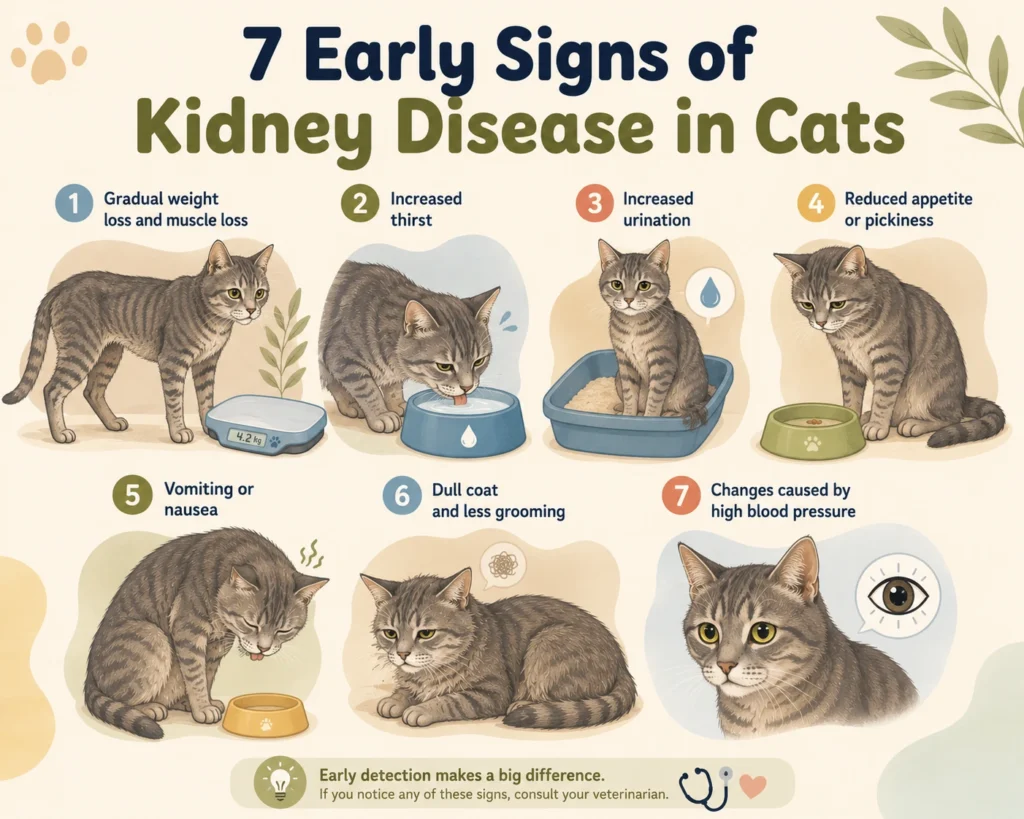
1. Gradual weight loss and muscle loss
One of the earliest signs of kidney disease in cats can be gradual weight loss and muscle loss, and it is also one of the easiest changes to miss. When you see your cat every day, a slow decrease over several months may be difficult to recognise, especially in long-haired cats that can look almost unchanged despite losing noticeable muscle underneath the coat.
You may first notice that the spine feels more prominent, the hind legs look thinner or the bones around the hips and shoulders are easier to feel. Weight loss in CKD can develop for several reasons, including reduced calorie intake, low-grade systemic illness, altered protein metabolism and declining appetite. Muscle mass may decrease along with overall body weight.
This muscle loss has another important consequence. Creatinine is produced partly from normal muscle metabolism, so a cat with substantial muscle loss may produce less creatinine. As a result, the blood value may appear less elevated than expected for the true degree of kidney dysfunction.
This is why tracking body weight over time can be surprisingly valuable. Rather than relying only on how your cat looks, consider recording weight regularly. During a senior health examination, your vet may also assess both body condition score and muscle condition score. A gradual downward trend deserves attention even if your cat is still eating, playing and behaving relatively normally.
2. Drinking more and producing more urine
Increased thirst and urination are among the most recognisable signs of kidney disease in cats. Healthy kidneys conserve water by producing concentrated urine when needed, but as kidney function declines, this concentrating ability may become impaired. The result is a larger volume of more dilute urine, which causes the cat to drink more in order to compensate for the additional water loss.
At home, you may notice your cat visiting the water bowl more often, drinking for longer periods or showing new interest in taps, sinks or other water sources. The litter tray can provide another useful clue. Larger or more frequent urine clumps may suggest increased urine production, and a persistent reduction in urine concentration can develop before severe clinical illness becomes obvious. Urine specific gravity, or USG, is therefore an important part of investigating suspected CKD.
However, increased thirst and urination are not unique to kidney disease. Diabetes mellitus, hyperthyroidism and several other conditions can cause a similar pattern. Among the signs of kidney disease in cats, the most useful clue is often a sustained change from your cat’s normal routine. If the water bowl suddenly needs filling more often or the litter clumps become consistently larger, mention the change to your vet.
3. A fussier appetite or subtle signs of nausea
Appetite changes can be among the early signs of kidney disease in cats, although they are often much less obvious than the repeated vomiting seen in more advanced CKD. A cat may still approach the food bowl and appear interested, only to sniff the food and walk away.
Others become increasingly selective, accepting a favourite food for a few days before suddenly refusing it. Subtle nausea may also appear as repeated lip licking, swallowing, drooling or chewing motions when no food is present.
These changes matter because persistent nausea and reduced calorie intake can contribute to the weight and muscle loss already associated with CKD. Rather than asking only whether your cat is still eating, pay attention to how eating behaviour has changed. Meals may take longer, food may be left behind more often, or your cat may seem hungry but repeatedly walk away after smelling the bowl.
However, appetite changes are not specific to kidney disease. Dental disease, gastrointestinal disorders, pain, hyperthyroidism and other illnesses can produce similar signs. Among the signs of kidney disease in cats, a persistent change in appetite is most useful when it appears alongside other changes such as weight loss, increased thirst or altered litter-tray habits.
4. Constipation or less frequent bowel movements
Changes in bowel habits can also be among the early signs of kidney disease in cats. Cats with declining kidney function may lose more water through dilute urine, and as the body tries to conserve fluid, the colon can absorb more water from its contents. This can lead to harder, drier stools and less frequent defecation.
At home, you may notice your cat spending longer in the litter tray, producing small hard stools or going longer than usual between bowel movements. Constipation can also reduce appetite and general comfort, creating another reason for an affected cat to eat less.
This sign can be harder to monitor in a multi-cat household. If one cat is being investigated for possible CKD, temporarily tracking which cat uses each litter tray can provide useful information and help you spot changes more accurately.
There is also an important safety distinction. A cat repeatedly straining in the litter tray may not be constipated. Difficulty passing urine, particularly in a male cat, can indicate urinary obstruction and requires urgent veterinary attention.
5. A dull coat and less grooming
A change in coat condition can be one of the more subtle signs of kidney disease in cats, although it is easy to dismiss as normal ageing. Cats are usually meticulous groomers, so a previously well-groomed cat developing a dull, flaky or clumped coat may indicate discomfort or systemic illness.
CKD can contribute in several ways. Chronic water loss may affect hydration and skin condition, while nausea and general malaise can reduce a cat’s interest in grooming. Muscle weakness or other age-related problems may also make grooming more difficult.
This sign is rarely useful in isolation. A senior cat with slightly poorer grooming but stable weight, appetite, thirst and behaviour presents a different picture from one whose coat is deteriorating while body weight is falling and water intake is increasing. Osteoarthritis can also make twisting and grooming painful, so changes in coat condition deserve a broader veterinary assessment rather than being attributed to kidney disease based on appearance alone.
If you are also noticing new night-time vocalisation, restlessness or other behavioural changes in an older cat, see our guide to why cats may start meowing at night. Several medical and age-related problems can overlap in senior cats, so the complete pattern matters more than one symptom alone.
6. Changes caused by high blood pressure
Systemic hypertension is an important complication of feline CKD and can be particularly dangerous because owners may notice little or no warning before high blood pressure begins damaging target organs. The eyes are especially vulnerable, and affected cats may develop enlarged pupils, difficulty navigating familiar spaces, disorientation or even sudden blindness.
Neurological signs can also occur in more severe cases. These are different from the subtle signs of kidney disease in cats that may appear during an early, stable stage. Sudden vision loss, seizures, severe disorientation or marked neurological changes require prompt veterinary assessment.
Blood pressure measurement is therefore valuable even when a cat appears reasonably comfortable at home. Veterinarians commonly assess blood pressure alongside kidney markers because hypertension can develop as a consequence of CKD and may also contribute to further kidney damage.
This relationship is one reason the International Renal Interest Society CKD guidelines include systolic blood pressure as part of CKD substaging.
7. Weakness, sleeping more or changes in behaviour
Senior cats naturally change as they age, but ageing alone should not automatically explain every reduction in activity.
A cat with CKD may begin sleeping more, interacting less or hesitating before jumping onto furniture. Some cats simply seem quieter. Several complications associated with kidney disease can contribute to weakness.
One is hypokalaemia, or low blood potassium. Potassium is important for normal muscle function, and excessive urinary losses can contribute to deficiency in some cats with CKD. Severe hypokalaemia can cause profound muscle weakness. In more obvious cases, a cat may struggle to hold its head normally.
Anaemia can also contribute to weakness in cats with more advanced CKD. The kidneys are involved in signalling red blood cell production, so declining kidney function can eventually affect the body’s ability to maintain an adequate red blood cell population.
However, reduced activity in an older cat has a long list of other possible explanations, including arthritis, heart disease, pain, hyperthyroidism and cognitive changes.
Again, the trend matters.
A cat that has always slept for much of the afternoon is less concerning than one that has gradually stopped jumping onto a favourite windowsill, lost weight and started drinking much more water.
Are these signs enough to diagnose kidney disease?
No.
This is one of the most important points for anyone researching signs kidney disease cats may show. Weight loss, increased thirst, appetite changes, constipation, poor grooming and reduced activity can all occur with other diseases.
CKD diagnosis requires veterinary assessment.
Your vet will usually combine the history you provide with a physical examination and appropriate laboratory testing. Depending on the cat, this may include blood tests, urinalysis, blood pressure measurement and diagnostic imaging.
In many cases, repeated measurements are more informative than a single result. A value can remain within the laboratory reference range while moving significantly away from your cat’s previous baseline.
This is particularly relevant when monitoring older animals over several years.
The bottom line
The early signs of kidney disease in cats may develop are often easy to overlook.
A little weight loss, more water disappearing from the bowl, larger urine clumps, a fussier appetite, harder stools or a coat that is no longer quite as tidy can all look insignificant when they happen gradually.
None of these changes confirms CKD.
Together, however, they can tell you that something has changed and that a veterinary check is worthwhile.
For senior cats, the most useful strategy is not to wait for a dramatic symptom. Know your cat’s normal habits, watch for trends and combine those observations with regular veterinary screening.
Kidney disease may be quiet in its early stages, but careful observation can help make those stages less invisible.
Frequently asked questions
What are the first signs of kidney disease in cats?
Early changes can include gradual weight or muscle loss, increased drinking and urination, appetite changes, subtle nausea, constipation, poorer grooming and reduced activity. People searching for signs of kidney disease in cats should remember that these changes are not specific to CKD, so veterinary testing is needed to identify the cause.
Can a cat have kidney disease with normal creatinine?
Yes. Creatinine can remain within the laboratory reference interval during earlier disease, and loss of muscle mass can also influence the result. Veterinarians may therefore consider SDMA, urine concentration, previous test trends and other findings alongside creatinine.
Do all cats with kidney disease drink more water?
No. Increased drinking and urination are common when the kidneys lose some of their ability to concentrate urine, but the change may be subtle or difficult for owners to recognise. This is one reason routine blood and urine screening is useful in senior cats.
How do vets confirm chronic kidney disease?
Diagnosis usually relies on persistent evidence of abnormal kidney structure or function. Blood markers, urinalysis, urine concentration, urine protein, blood pressure and imaging may all contribute depending on the case. Results need to be interpreted alongside hydration status, medical history and previous measurements.
Can chronic kidney disease in cats be cured?
Established CKD is generally not reversible. Treatment instead focuses on slowing progression where possible, controlling complications and maintaining quality of life. The management plan depends on the stage of disease and the problems identified in the individual cat.
How often should a senior cat have a health check?
The appropriate schedule depends on the cat’s age, previous results and health status. Senior cats benefit from regular veterinary examinations because subtle disease can develop between visits. Your vet can recommend an individual screening interval and decide which blood, urine or blood pressure tests are appropriate.